Glossary
Transcript (What’s Up English Podcast)
One sign that the broth is good is that the color is clear, but it’s really rich and flavorful. What’s up, everyone? Podcast Slow and Clear của What’s Up English. Today we are going to talk about Vietnamese food. Now, I know many of you guys are in different parts of Vietnam. Some of my viewers are in the northern regions, some are in the central regions and some are in the southern regions.
So because of that, I will talk first about food overall in Vietnam. So if a foreigner asks you like “What is Vietnamese food like?”, you will be able to give them a description of food in Vietnam. After that, I’m going to talk about each region. So first I will talk about the northern region and the food there, like food in Hanoi, and then the central region, and then finally, I will talk about the southern region. I won’t only talk about the food in general, but for each region, I will also talk about a famous dish. So no matter what region you live in, you will be able to talk about the food from where you are from. Then finally, at the end of the podcast, I will tell you guys which type of food I like more… if it’s Western food or Vietnamese food.
Which one do I prefer? And guys, in this podcast, there will be quite a few words that might be new for you. So remember to download the PDF in the description below that has all of the vocabulary words from this podcast as well as the transcript. So you can read everything I said again, and practice speaking for yourself. All right, let’s get back to the podcast.
Vietnam is a country with a ton of agriculture, right? And agriculture means farming. Vietnam grows a lot of vegetables and herbs. So of course, there are a lot of fresh vegetables and herbs in Vietnamese cuisine. By the way, the word “herb”, you can say “erb” like they say in the USA, or you can say “herb.” It’s up to you. And some staple ingredients in Vietnamese food are things like rice, of course, and the rice can come in different forms, so it can be steamed rice, which is probably the most common one…
Rice wraps, it can be in rice noodles, it can be sticky rice. And one very common drink throughout all of Vietnam is iced tea. Trà đá. So if you’re wondering how to say “trà đá” you can just say iced tea, iced tea. And then there are the herbs and vegetables. Some common herbs in Vietnamese cuisine are basil, cilantro, mint. And then there are vegetables like green onions, bean sprouts, bamboo, cabbage, morning glory, garlic. Many different ones. The proteins in Vietnamese food…
Seafood is common. So you guys eat a lot of shrimp and fish. Also pork, beef, chicken and tofu. Now, sauces are a huge thing in Vietnam. I read somewhere that Vietnam is the country of sauces. So in Vietnam, fish sauce is very common. You guys put shrimp paste in your soups, there’s soy sauce, and there’s, of course, a huge variety of dipping sauces. And again, Vietnam is very famous for dipping sauces.
Now, the ways of cooking Vietnamese food can be grilling, boiling, steaming and stir frying. And of course, there are more. But those are the main ways of cooking. Of course, the cuisine of a country is going to be influenced by the geography. So for Vietnam, it allows to grow a lot of vegetables. So there are a lot of vegetables in the cuisine, but also the countries around it. So Vietnamese cuisine was influenced by China, other countries around Southeast Asia, so, close to Vietnam, and especially France. France brought coffee and like baguettes, like the loaves of bread to Vietnam, which are still very popular to this day. So that was Vietnamese food in general, in a nutshell.
Now I will go over each region. So let’s start with the Northern Vietnamese food. Because in the north, the climate is cooler than in the south, so they don’t grow as many vegetables. Because of that, the food in the north is milder than the food in the south. Milder means not as spicy, and they don’t use quite as many vegetables like fresh vegetables as in the south. Also, the food in the north is more salty than sweet. And I will talk about southern food a bit later.
One very common dish, of course, in the north is phở, right? Phở is Vietnam’s signature dish. If you ask any foreigner around the world about Vietnamese food, they will probably just tell you phở right. Or as they say, “pho.” Even I used to say pho before I came to Vietnam. And then my friend was like, “It’s not pho, it’s phở.” And I’m like, “okay, fine, phở.” So yeah, there are two common types of phở, and that is beef and chicken phở. Now these two types are different, so the beef is usually thinly sliced and it can be pre-cooked or raw. And if it’s raw, it is put in the bowl and then the hot broth poured on top will cook it. And speaking of broth… One sign that the broth is good is that the color is clear, but it’s really rich and flavorful. Really delicious. Even though the color of it is pretty clear.
For chicken phở, they usually use chicken leg that is chopped up, including the skin and some bone. Like I said before, northern phở is different to southern phở because the phở in the south is a bit sweeter and bolder than the phở in the north. And if you go to any like phở restaurant outside of Vietnam, like if you went to Canada or the USA or England, and you went to a restaurant, it would most likely be Southern phở, because I’m assuming most of the people who left Vietnam, who emigrated from Vietnam about 40 years ago, 50 years ago, were from the South. So when they opened phở restaurants, it was Southern phở. For garnishes in phở in the north, often they add things like green onion and cilantro, whereas in the south, they will add bean sprouts and basil. And in the south, they might also add Sriracha sauce or hoisin sauce. But in the northern phở, they usually don’t add those sauces. Maybe they will add some vinegar or some chili sauce, but that’s about it.
Now, if you want to talk about some ingredients in phở, you can say it has beef bones, star anise or star anise, ginger, cinnamon, charred onion. So charred just means burnt. Cloves, cardamom pods, and, of course, salt, fish sauce or and MSG. And the way they cook the broth is they simmer everything for a long time. So I can’t explain exactly how it’s cooked because I don’t really know. But what I can tell you is that they put many ingredients in a large pot and they simmer it for a long time to pull out all of the flavor.
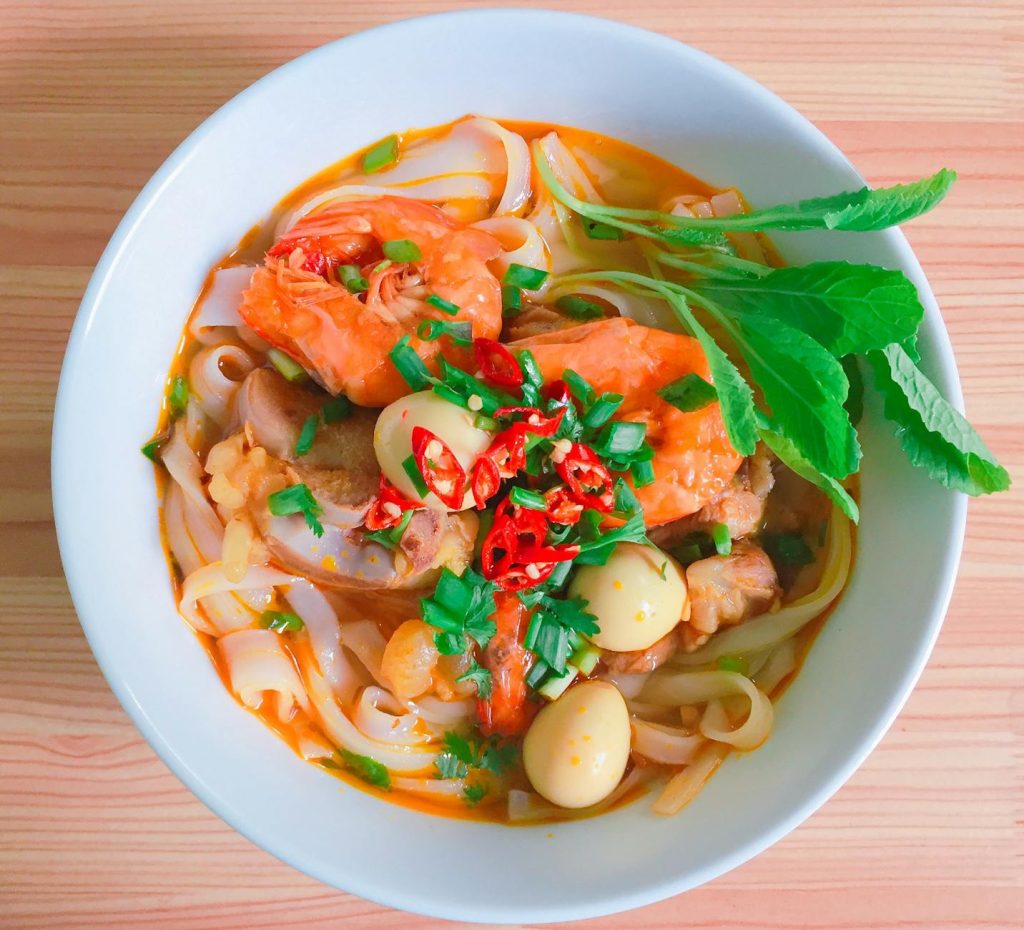
All right, so let’s move to central Vietnamese food. So central Vietnamese food is known to be spicier and bolder in flavor than the north and the south. Now, the dishes are also more complex because in the central area is Huế, Huế used to be the imperial capital of Vietnam. Like the old capital. And royalty lived there. So they would make the dishes more intricate and complex and they would also be smaller servings because in one meal they would have more smaller dishes. Now, the dish we will talk about from the central area, you can probably guess is… Bún bò Huế. Now, the secret in this dish is in the broth. The broth is spicy, sour, salty and umami. And it’s a symbol of the bold nature of the cuisine in this area. Unlike the clear broth of the broth of phở, the broth of bún bò Huế is red. And that is from Annatto seeds. So this dish can also be seasoned with lemongrass, shrimp paste, and the meat is usually marinated beef shank. Also, they can put in pork knuckles, oxtail, and one special ingredient is pork blood cubes. All I could find on the internet for the English word for these was pork blood cubes. It doesn’t sound very appetizing, but that’s what you can say. Now the noodles are called rice vermicelli noodles. So if you’re wondering “What is bún in English?”, it is vermicelli noodles or rice vermicelli noodles. You can eat it with vegetables and herbs on the side like basil, and sliced banana blossom, bean sprouts. And the chili paste with bún bò Huế is so spicy. I wouldn’t call this chili sauce because it’s more thick and it’s not like a liquid. So I would say it’s more like a chili paste.
Now let’s move to the Southern Vietnamese food. So Southern Vietnamese food is usually sweeter because they use more sugar and coconut milk in their cooking. And they also use more herbs and vegetables because of the warm climate and the Mekong Delta, which is a very fertile area where they can grow a ton of agriculture. So there’s also a lot of seafood because again, it’s close to the Mekong Delta rivers and it’s near the coastline. For the special dish of southern Vietnamese food, can you guess it? If you guessed cơm tấm then you are correct. In English, cơm tấm can be called “broken rice.” This dish actually has a pretty interesting history, which is, back in the day, so in the late 19th century, which is the late 1800s, the farmers would eat broken rice because there was not enough full rice to go around or it was too expensive. So what they did was they ate broken rice, and broken rice was a byproduct of the rice milling process. The process of making rice would create mostly full rice grains that we see today. But a byproduct was also many of these broken grains of rice that were kind of set aside.
So these broken rice grains were cheaper than the full ones. And so people thought… it’s still rice, we might as well eat it. This dish started to become more popular, and then later on, they started to modify this dish to suit the tastes of visitors from like France, America, China. So they added grilled pork, which is what we often see now, is like a grilled slice of pork. And also there is steamed omelet. So a steamed omelet is basically steamed egg. I saw online some people called it “steamed egg meatloaf,” but “egg meatloaf” doesn’t really make sense. I would just call it a steamed egg omelet. So now to have come from broken rice, people have to purposely break the rice in order to have the rice like that. Some of the main ingredients of this dish are pork chops, thinly shredded pork rind with roasted rice powder. So if you were wondering what is the name of that powder on the pig skin, it’s roasted rice powder. Again, so steamed omelet or steamed egg meatloaf. And on the side, there are some vegetables like tomato and cucumber. And also you can garnish it with green onion. There’s also usually a sweet chili dipping sauce that can be made from fish sauce, garlic, chili, sugar vinegar and a bit of water. So that about sums up a lot of important information about Vietnamese food. I know it’s not everything. I know there were many things that I missed, simply because we don’t have the time to talk about it. There’s so many interesting things about Vietnamese food, but I hope that was useful for you.
Now I will tell you guys which food I like more, if it’s Western food or Vietnamese food. And the answer is… It depends, right? Sometimes I want to eat Western food. Sometimes I want Vietnamese food. Now, one thing that’s really great about Vietnamese food is that it’s light. You can eat a lot of it and you won’t feel sick. So personally, I can eat phở every day, and I do eat phở every day for lunch. I go to the same restaurant for beef phở, I don’t even have to say anything because they know what I’ll order. But then sometimes if I want to eat something that is heavy, that will make me feel really full, that has like oil in it. Then I will eat some Western food. And for me, it’s not just Western food, but… any international food, really. Like I love Indian food, Mexican food, American food. Um, I’d say those are my three favorites. Greek food is really good… Italian food. So Vietnamese food I eat the most often. But sometimes if I want something heavier, something really rich, then I will go for Western food. And again, one thing I really love about Vietnamese food is you can eat it and you’re not going to feel sick. You don’t really have to feel bad because it’s a really light food that you can eat and go, and you won’t be in a food coma after you eat it. So, guys, that is it for this podcast. I really hope it was useful for you. Don’t forget to download the PDF in the description below so you can review all of the words that I said today and you can read the transcript as well. If you want to keep learning conversational English, Click the link up there and I will see you in the next video. Goodbye!